
REVIEW · SIDECAR TOURS
Lisbon El Cristo-Rei – Private Vintage Sidecar Tour
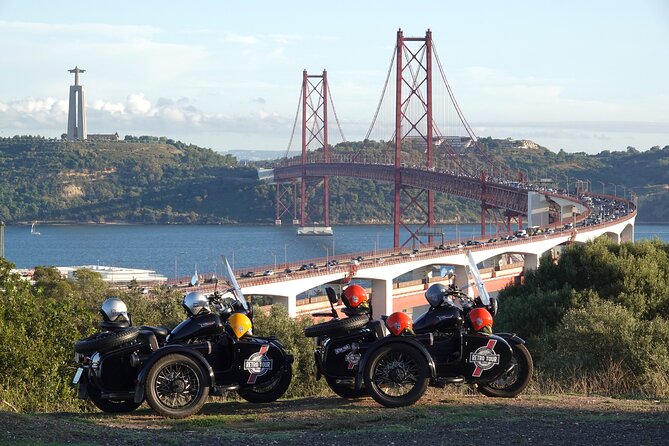
Lisbon’s best city view may come after you leave the city. This private vintage sidecar tour crosses the Tagus on the 25 de Abril Bridge, then climbs to the Sanctuary of Christ the King, where Lisbon opens below you. Along the way, you pass old churches, azulejo-covered buildings, the Bica tram, and places tied to Portugal’s dictatorship and revolution.
I like two things right away: the route reaches beyond central Lisbon, and the private format lets Stéphane or Frédéric adjust the pace for photos and personal interests. The fresh air, comfortable sidecars, phone chargers, and new equipment add real comfort. The main consideration is the price, $360.23 for up to two people, which makes sense for a private ride but is not a budget sightseeing option.
Key points worth knowing before you book
- Cross the Tagus by sidecar: The tour gives you a quick and memorable way to reach Cristo-Rei from Lisbon.
- See more than a postcard view: Historic churches, the Bica tram, azulejos, archaeology, and the end of dictatorship all fit into the route.
- Private guides Stéphane and Frédéric: You can ask for photo stops or adjust attention toward the sights that interest you most.
- Casa da Cerca adds a calm pause: Expect coffee, contemporary art, umbrella pines, and a framed view over the river.
- The ride is well equipped: Helmets, gloves, goggles, private transport, support, and phone chargers are included.
- Two hours moves quickly: This is a strong overview and a good first look, not a slow museum tour.
Why a vintage sidecar works well in Lisbon
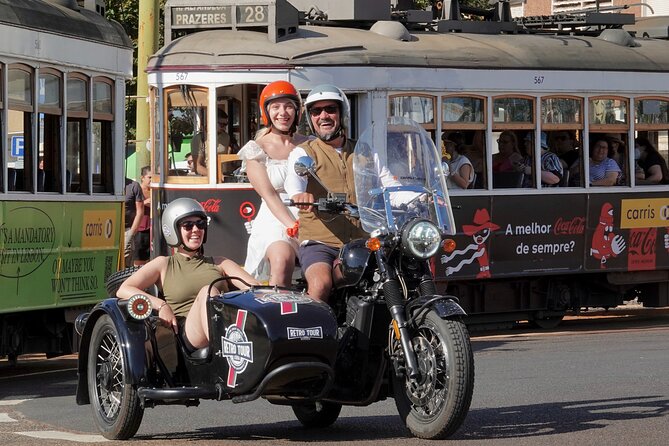
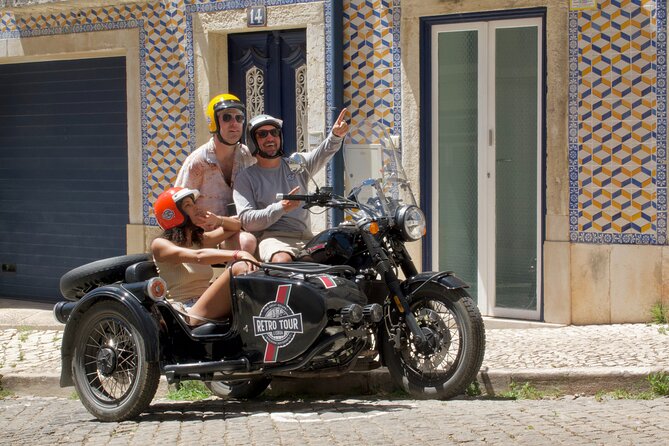
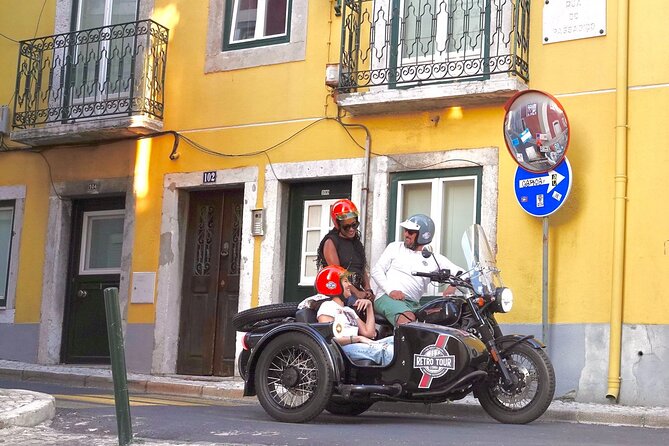
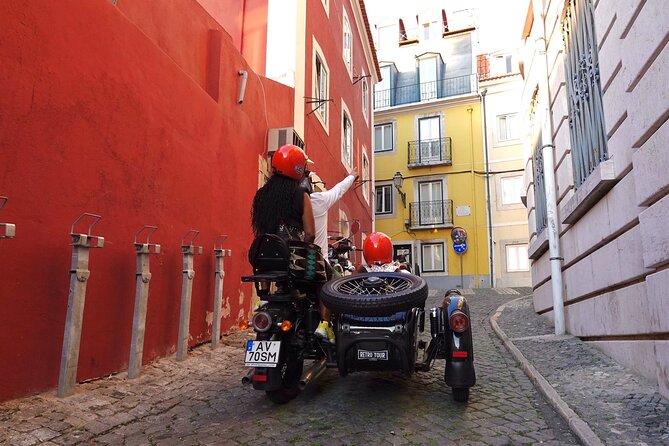
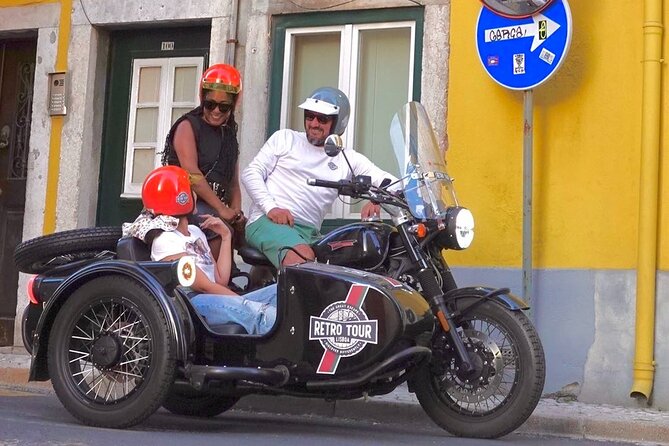
A sidecar gives you something a bus cannot: open air, a low seat, and a close view of the streets. You are not sealed behind glass, and you can talk with the guide while moving. That makes the ride part of the sightseeing rather than just a transfer between stops.
The private setup matters most here. Your group is limited to two, so Stéphane or Frédéric can make room for a photo or give more attention to the sites you care about. The tour is not locked into a large group’s timetable. A previous rider particularly valued the relaxed mood, the ability to ask for personalized stops, and the chance to charge a phone on the sidecar.
The equipment is another practical plus. Helmets, gloves, and goggles are provided, and the motorcycles and riding gear are described as new. You will still want sensible clothing for a moving ride, since the open sidecar brings a cool breeze even on a mild day.
The tour lasts about two hours. That is enough time to connect several parts of Lisbon and Almada, but it also means the stops are short. You will see and understand the main points, then move on. If you want long interior visits, extended gallery time, or a leisurely coffee, you will need a separate outing.
More Sidecar Tours in the world:
- Barcelona Private Tour by Sidecar Motorcycle
★ 5.0 · 1,750 reviews - Paris Vintage Private City Tour on a Sidecar Motorcycle
★ 5.0 · 417 reviews - Paris Highlights city tour on a vintage Sidecar Motorcycle
★ 5.0 · 168 reviews
Old Lisbon stories before the bridge
The early part of the route gathers several layers of Lisbon in a small area. One stop brings together a 14th-century church, archaeological finds, an aqueduct fountain, and the place where Portugal’s dictatorship ended in 1974.
The church is linked with Portugal’s preserved independence, giving the stop a national story rather than just an architectural one. The archaeological setting also reaches beyond Portugal. Finds displayed here include Peruvian mummies, and the site serves as the headquarters of Portuguese archaeologists. That combination makes it a useful reminder that Lisbon’s past is not limited to grand monuments and royal buildings.
The fountain points to Lisbon’s old water system. The open-water aqueduct was built around 1730, with roughly 58 kilometers of galleries. It supplied the western parts of the city, including areas around Bairro Alto, Ajuda, Belém, and Amoreiras. A quick look at the fountain gives you a practical sense of how the city once solved its water problem.
The final historical note is political. In 1974, Marcello Caetano, who had replaced António de Oliveira Salazar in 1968, was removed from power and sent to Brazil. The tour links that turning point to the physical place where the dictatorship ended. You get a short lesson in modern Portugal without sitting through a formal lecture.
Because the name of this first stop is not specified, treat it as a guided area visit rather than a ticketed attraction with a clearly defined entrance. The value comes from the connections your guide makes among church, archaeology, water, and politics.
Rua da Bica and Lisbon’s yellow tram
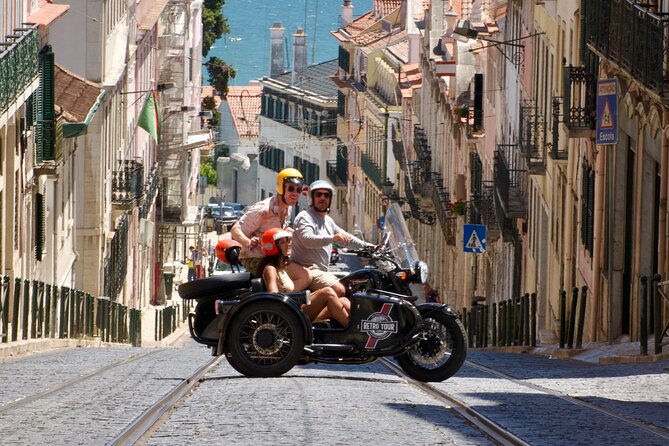
Rua da Bica brings you to one of Lisbon’s most recognizable street scenes: the yellow tram climbing the steep route. The stop lasts about five minutes and has no admission charge.
That short pause is mainly for orientation and a photograph. The Bica tram is one of those sights that explains Lisbon at a glance. The narrow street, steep grade, and bright tram show why the city’s public transport became part of its visual identity.
Do not expect an extended ride on the tram as part of this experience. The listed stop is brief, so the sidecar is doing the work of moving you through the city. If the tram is your main reason for visiting Bica, return later and give the neighborhood more time on foot.
Visconde do Sacavèm Palace and the azulejo tradition
The Visconde do Sacavèm Palace is a smaller but distinctive stop. The building is covered with magnificent azulejos, the painted ceramic tiles that appear across Portuguese churches, palaces, stations, and ordinary façades.
The palace is classified as municipal heritage and was built in only three years, from 1897 to 1900. That compact construction date places it in a period when decorative detail carried real social weight. Here, the tiles are not just colorful decoration. They help show how Portuguese architecture uses pattern, surface, and storytelling.
This is a good stop for people who enjoy details more than grand scale. You will not get the same broad river view as at Cristo-Rei, but you will see a more intimate side of Lisbon’s built heritage. Ask your guide to point out the tile work and give you time for a close look, since a passing glance can miss the reason this palace is protected.
More Vintage and Classic Motorcycle Tours in the world:
- Hanoi Motorbike Tour: Food, Culture and Fun by Vintage Motorbike
★ 5.0 · 6,699 reviews - VIETNAM BACKSTREET TOURS: Explore Bat Trang Ceramic Village By Minsk Motorcycle
★ 5.0 · 228 reviews - 2hr Retro Motorcycle Sidecar Oslo Highlights Tour
★ 5.0 · 115 reviews - Hanoi Food, Culture, Sightseeing & Fun By Vintage Motorbike
★ 5.0 · 86 reviews
Crossing the 25 de Abril Bridge
The bridge crossing is the tour’s big movement moment. Built from 1962 to 1966, it was created to make travel between the two banks of the Tagus easier. The same bridge has carried three names: the Bridge over the Tagus, Salazar Bridge, and the 25 de Abril Bridge.
That name change tells you something about Portugal’s political history. The bridge first carried the name of the dictatorship’s leader, then took its current name after the 1974 revolution. The ride connects the engineering project with the political changes that reshaped the country.
From the sidecar, you get an open-air crossing rather than a distant view of the structure. The ride also saves time compared with trying to build the same route through separate transport connections. This is one of the strongest reasons to choose the experience over a standard central Lisbon sightseeing loop.
The crossing can also be the most exposed part of the ride. The tour requires good weather, and that rule makes sense here. If poor weather cancels the experience, you are offered another date or a full refund. For your own comfort, check the forecast before you commit to the day.
Christ the King for the wide Lisbon view
The Sanctuary of Christ the King is the main destination. The statue was inspired by the Christ the Redeemer statue in Corcovado, Brazil. A Portuguese cardinal visited Brazil in the 1930s and later supported the idea of a similar figure protecting Lisbon. The monument took shape between 1949 and 1959, after the Second World War.
The stop lasts about 15 minutes, with admission included. That gives you time to take in the statue and the view, but not much room for a long visit. The appeal is the position across the river, where Lisbon’s hills, the Tagus, and the bridge can be understood together.
This is where the sidecar route earns its price. From central Lisbon, Cristo-Rei is close enough to seem simple on a map but separated by the river and bridge. The private ride turns that separation into part of the experience.
Still, keep your expectations practical. Fifteen minutes is a photo and viewpoint stop, not a full religious or architectural visit. If you want to study the sanctuary in detail, plan a return visit. The tour gives you the essential setting and story, then keeps moving.
Coffee and contemporary art at Casa da Cerca
Casa da Cerca, the Contemporary Art Center, provides the tour’s quietest pause. The stop lasts about 10 minutes and includes admission. You get coffee, an art gallery, and a view framed by umbrella pines.
This is a smart contrast to the bridge and statue. After the movement of the ride, you have a short chance to sit, look at art, and take in the river setting. The umbrella pines give the view a natural frame, so the stop feels more composed than a quick roadside lookout.
The coffee break is brief, and snacks are not included. That distinction matters if you are booking the tour near lunchtime. Bring your own plan for food, since the included stop is a small refreshment break rather than a meal.
Casa da Cerca also gives the route some cultural balance. The tour does not focus only on monuments and photographs. You get a contemporary art center and a place to pause, which helps the two-hour ride feel less like a checklist.
What $360.23 means for two people
The listed price is $360.23 per group of up to two, not per person. For a couple, that works out to about $180 each. It is a high price for a two-hour activity, but the comparison should be with a private vehicle and guide, not with a public tram ticket.
The cost covers private transportation, the sidecar ride, support, safety equipment, and included admission at Christ the King and Casa da Cerca. You are also paying for a route that crosses the river and connects central Lisbon with Almada in a short period.
I would consider it good value if you want a special introduction to Lisbon, have limited time, or dislike large group sightseeing. It is less attractive if you are watching every euro, already plan to visit Cristo-Rei independently, or prefer spending hours inside each attraction.
The price is easiest to justify for two people sharing the group cost. Solo visitors pay the same group rate, so the value calculation changes. Since the experience is usually booked about 12 days ahead, give yourself some planning time if you want a particular date.
Practical details for a smooth ride
The meeting point is R. Garrett 88, in central Lisbon. The tour ends at Praça do Comércio, with drop-off available in central Lisbon or back at the starting point. Pickup is offered, so confirm the exact arrangement when you book.
The experience is offered in English. Stéphane and Frédéric are the named guides associated with the ride, and the private format lets you communicate directly with your guide while moving.
Your booking confirmation arrives at the time of booking. Service animals are allowed, public transport is nearby, and most people can participate. Since this is a motorcycle sidecar experience, tell the provider about any concern before the day of the ride rather than waiting until you arrive.
Free cancellation is available up to 24 hours before the local start time. Changes or cancellations made inside that window are not refunded. Bad weather is handled differently: the provider offers another date or a full refund if conditions force cancellation.
The tour includes helmets, gloves, and goggles. Snacks are not included. A phone charger is available on the sidecar, a small detail that matters when you are taking photos through the ride.
Who should book this private Lisbon tour?
I would choose this for a couple who wants an unusual way to get oriented, especially on a first Lisbon visit. It suits people who like history in small portions, open-air transport, viewpoints, and the freedom to stop for pictures.
It is also a good fit if you have already seen central Lisbon and want to cross the Tagus without arranging a separate day trip. The bridge, Cristo-Rei, and Casa da Cerca give you a different view of the city than the usual Baixa, Alfama, and Belém circuit.
I would hesitate if you want a slow, scholarly tour. The stops are short, the total time is limited, and the experience depends on good weather. Families or groups larger than two should also check the group arrangement carefully, since the advertised private price is for up to two people.
Should you book the sidecar ride?
Book it if you want the ride itself to be part of the pleasure. The open sidecar, flexible photo stops, new equipment, and direct route across the Tagus create a memorable two-hour introduction. The strongest features are the access to Cristo-Rei and the private pace, not the length of the individual visits.
Skip it if $360.23 feels too steep for a short tour or if you prefer to linger at museums and monuments. For the right pair, though, this is a practical splurge: you cover a lot of ground, hear about Portugal’s political and architectural past, and see Lisbon from across the river without the usual transport fuss.
FAQ
How long does the Lisbon vintage sidecar tour last?
The tour lasts approximately two hours.
What is included in the price?
The price includes private transportation, support, a helmet, gloves, goggles, and admission at the included attractions listed for the route.
Are snacks included?
No. Snacks are not included, although the Casa da Cerca stop includes a coffee break.
Where does the tour start and end?
It starts at R. Garrett 88, 1200-204 Lisbon, Portugal. It ends at Praça do Comércio, with drop-off available in central Lisbon or at the starting point.
Is the tour private?
Yes. This is a private activity for your group, with a listed capacity of up to two people.
What happens if the weather is poor?
The experience requires good weather. If it is canceled because of poor conditions, you can choose another date or receive a full refund.
Recently added around the world
- Motorbike adventures on a dual purpose motorbike in the Garden Route and Karoo.★ 5.0 · 3 reviews
- Visit 5 Districts & The Hidden Gems In Saigon By Motorbike★ 5.0 · 8 reviews
- Visit Villages, Terrace Rice Field with Easy Riders half day★ 5.0 · 2 reviews
- Motorcycle day tour to Rila monastery★ 5.0 · 2 reviews
- Motorcycle rental Trogir / BMW F850GS / Your own motorbike tour★ 5.0 · 2 reviews
- Visit all place in Sa Pa with easy riders★ 4.8 · 5 reviews
- Lisbon – Private Vintage Sidecar Tour to Sesimbra’s Coast★ 5.0 · 13 reviews
- Bali Black Sand Beach Motorcycle Photo Tour★ 5.0 · 2 reviews
Sidecar Tours, side by side.

Barcelona Private Tour by Sidecar Motorcycle
Read our review →
Paris Vintage Private City Tour on a Sidecar Motorcycle
Read our review →
Paris Highlights city tour on a vintage Sidecar Motorcycle
Read our review →

Meursault: Tour of the Vineyards on Motorbike with Sidecar
Read our review →
Paris Vintage Sidecar Tour – Emily in Paris highlights
Read our review →

Lists this ride turns up in